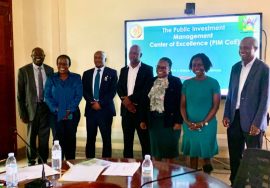

PIM Centre Trains Government Officials in Regulatory Cost-Benefit Analysis
2nd November, 2026–Makerere University’s Public Investment Management Centre of Excellence has begun a two-week intensive training for government officials aimed at strengthening the analysis of policy and legislative proposals and improving the quality of financial decisions across government.
The training, conducted in partnership with the Ministry of Finance, Planning and Economic Development, focuses on Integrated Regulatory Cost-Benefit Analysis under the revised Guidelines for Financial Clearance.
Participants drawn from government ministries, departments and agencies are being equipped with practical skills to assess the financial, economic and wider implications of policies, Bills and other proposals before they progress through government decision-making processes.

Opening the training, Mr. Paul Mwanja, Commissioner for Infrastructure and Social Services at the Ministry of Finance, Planning and Economic Development, said the capacity-building programme comes at an important stage in the implementation of Uganda’s revised financial clearance framework.
He noted that the Certificate of Financial Implications is an important safeguard for ensuring that policy and legislative proposals submitted to Cabinet or Parliament are consistent with government’s fiscal objectives and national development priorities.
“The success of these reforms does not only depend on the strength of the guidelines, but also on the competence and commitment of those who implement them,” Mr. Mwanja said.
The revised Guidelines for Financial Clearance came into effect on 1 July 2025 and introduced stronger institutional and analytical requirements for the consideration of policy and legislative proposals. These include evidence that Regulatory Impact Assessments have been undertaken, preparation of Statements of Financial Implications, consultations within ministries, departments and agencies, and Integrated Regulatory Cost-Benefit Analysis by the Ministry of Finance.
Mr. Mwanja said the training is intended to equip planners, economists and policy analysts with the technical skills and strategic understanding required to apply the framework in practice.
He linked the training to the implementation of the Fourth National Development Plan and the Tenfold Growth Strategy, noting that stronger analysis would help ensure policy proposals are aligned with Uganda’s longer-term development objectives.
“We shall continue investing in systems, gathering feedback and supporting learning to ensure that our public finance architecture remains responsive, efficient and fit for purpose,” he said.
He added that additional officers would be trained in subsequent cohorts as government works to build a critical mass of professionals capable of rigorously assessing policy and legislative proposals.
Building practical analytical capacity

Welcoming participants, Dr. John Sseruyange, Manager of the Public Investment Management Centre of Excellence, emphasised that the training has been designed to move beyond theory and enable participants to independently undertake the analyses required under the new framework.
The two-week programme combines classroom sessions with hands-on practical work. Morning sessions focus on concepts and analytical approaches, while afternoons are devoted to practical exercises and modelling.
Dr. Sseruyange urged participants to view the training not only as an institutional requirement, but also as an opportunity to strengthen their individual analytical capacity.
“Do not think only about helping the entity you have come from. Think about developing your own capacity,” he told participants.
He explained that many of the analytical tools used in examining policies and Bills are also applicable to public investment project analysis, giving participants skills that extend beyond the immediate requirements of the financial clearance guidelines.
The Centre has drawn trainers and technical expertise from Makerere University and government institutions, including the Ministry of Finance and the National Planning Authority, to support both the theoretical and practical components of the programme.
From guidelines to evidence-based decisions
In remarks delivered on his behalf, Prof. Edward Bbaale, Director of the Public Investment Management Centre of Excellence, said the training follows the dissemination of the revised guidelines for the Certificate of Financial Implications in June 2025.
He said the guidelines place increased emphasis on robust, evidence-based Statements of Financial Implications before policy proposals and Bills proceed.

Over the two weeks, participants will develop competencies in risk analysis, cost-effectiveness analysis, analytical modelling and financial modelling, as well as the application of parameters such as prices, exchange rates and discount rates in policy evaluation.
They will also learn how to prepare Statements of Financial Implications to support decision-makers in assessing new policies and legislation.
Prof. Bbaale said these capabilities go beyond fulfilling a procedural requirement.
“These skills are not only technical requirements in the revised guidelines, but they are also essential for ensuring that Uganda’s public policies are sustainable, equitable and aligned with our national development goals,” he said.
He noted that the Public Investment Management Centre of Excellence continues to support government through training, research, outreach and advisory services. Recent work highlighted in his remarks included contributions to the revision of the Development Committee Guidelines, assessment of public investment project performance and convening of the second Public Investment Management Conference on 14 August 2025.
The training forms part of a broader effort to strengthen the analytical capacity available within government so that financial and policy decisions are increasingly informed by evidence, fiscal realities, potential risks and their implications for citizens.